Mechanism of heterochromatin assembly
Our primary goal is to investigate how histone-modifying activities coordinate during heterochromatin formation in the fission yeast Schizosaccharomyces pombe. To identify new pathways that regulate heterochromatin formation, we have developed a high-throughput screening system using the fission yeast deletion library. Additionally, we employ biochemical and genomic approaches to uncover the underlying molecular mechanisms.
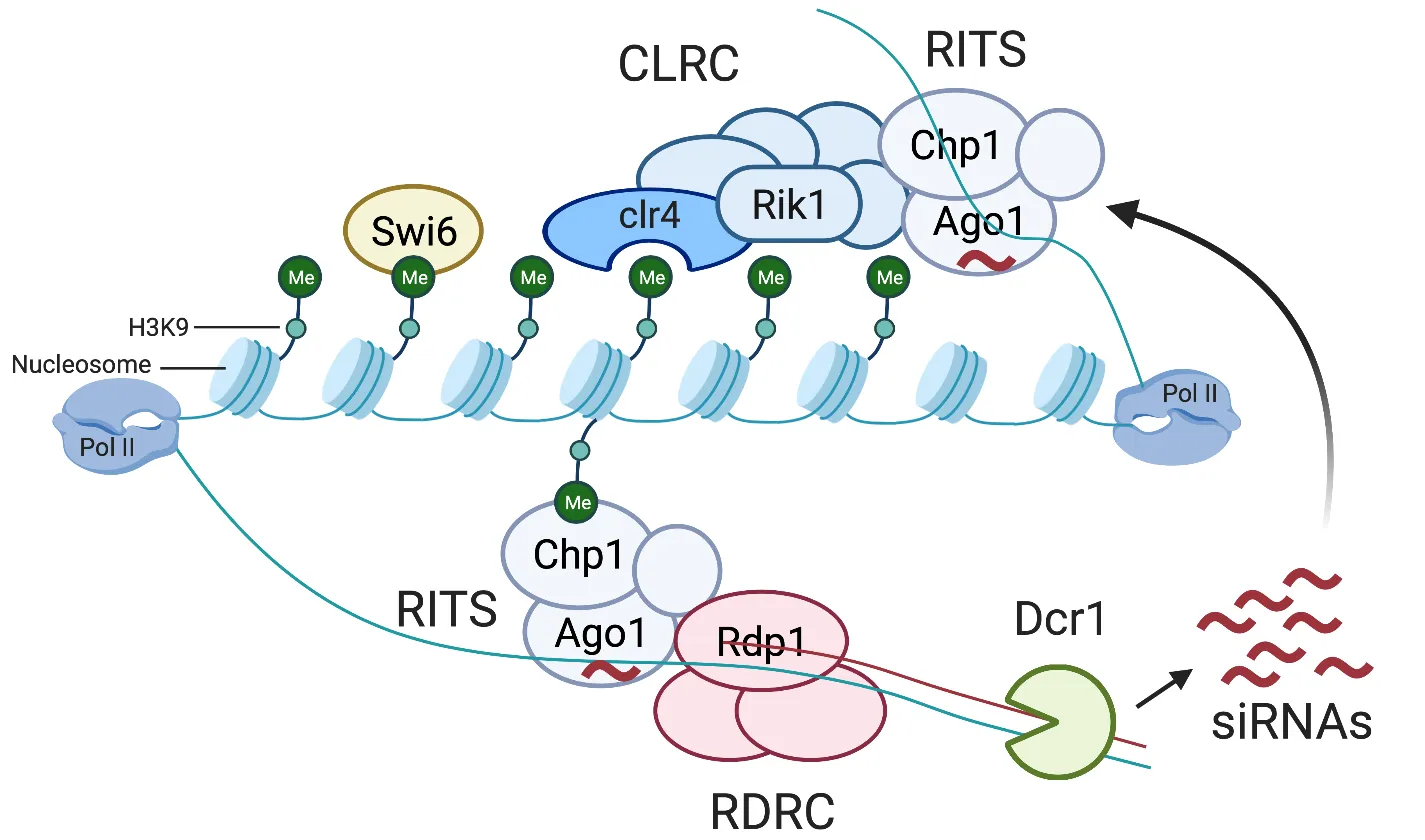
The RNA interference (RNAi) pathway plays a crucial role in recruiting the H3K9 methyltransferase Clr4 to establish heterochromatin at repetitive DNA present in all major heterochromatin domains. Initially, the DNA repeats are transcribed, generating double-stranded RNAs (dsRNAs). Ribonuclease Dicer (Dcr1) processes these dsRNAs into small interfering RNAs (siRNAs), which are loaded onto the RNA-induced transcriptional silencing complex (RITS). Within RITS, the Argonaute protein (Ago1) binds siRNAs and guides the complex to nascent RNA transcripts from repeat regions. Subsequently, RITS recruits the Clr4 complex (CLRC) to initiate H3K9me3, resulting in the formation of heterochromatin. We are currently using high-throughput genetic screens to identify regulators of RNAi and histone modification pathways that promote heterochromatin formation,
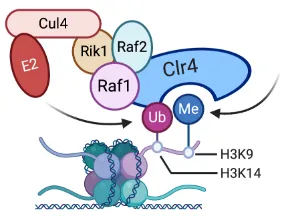
Recent studies have shown that the activities of H3K9 methyltransferases, such as fission yeast Clr4 and mammalian SUV39H1, are stimulated by the ubiquitylation of H3K14 (H3K14ub). In fission yeast, the Cul4-Rik1-Raf1-Raf2 E3 ubiquitin ligase associates with Clr4 to form CLRC, which is responsible for both H3K14ub and H3K9me. We are investigating how H3K14ub stimulates Clr4 enzymatic activity using both biochemical and structural approaches. Additionally, we are identifying regulators of H3K14ub through genetic screens. These studies will provide critical insights into the mechanisms of crosstalk between histone modifications.