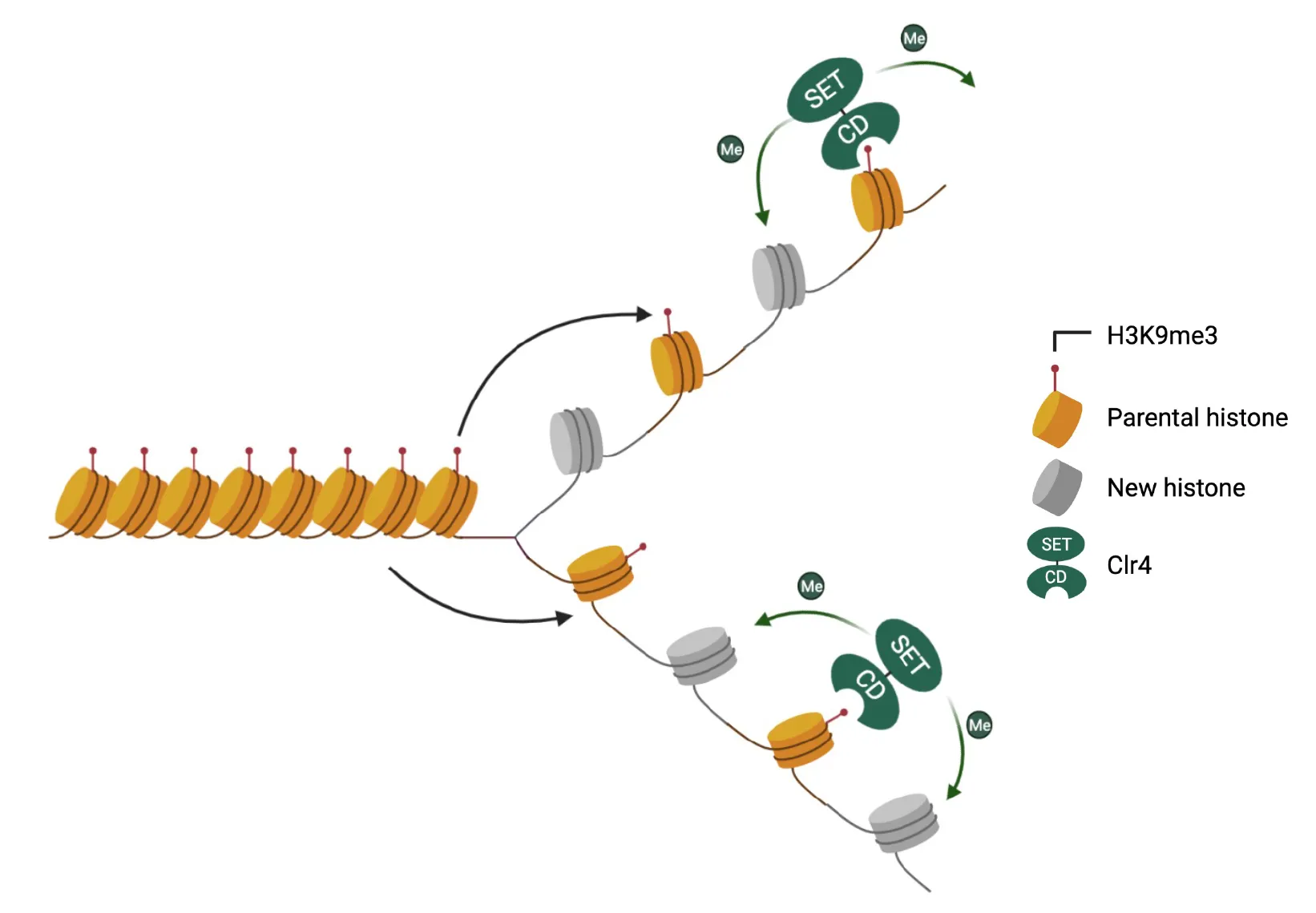
Mechanism of histone-based epigenetic inheritance

During DNA replication, parental histones, which contain the original histone modifications, are deposited back into their original locations and equally segregated onto both daughter strands to direct the formation of nucleosomes. The existing modifications on parental histones then serve as templates to restore the original histone modification profiles on both replicated chromatids. We use fission yeast heterochromatin as a model to study how this chromatin state is inherited during DNA replication.

At heterochromatin regions, the histones are marked with H3K9me3. During DNA replication, parental (H3-H4)2 tetramers are deposited back into their original location and are equally segregated onto both daughter strands. The histone H3K9 methyltransferase Clr4 contains a catalytic SET domain and a chromo domain that recognizes H3K9me3. Parental histones containing H3K9me3 recruit Clr4 to modify nearby nucleosomes formed by newly synthesized histones, thereby duplicating the histone modification on both replicated DNA strands. We have found that a low histone turnover rate is critical for the proper inheritance of heterochromatin.